
The Ongoing risk
of COVID-19 remains a serious health concern1,2
The COVID-19 landscape is constantly changing due to SARS-CoV-2 evolution and the emergence of new variants.2
SARS-CoV-2 can have a multisystemic effect across the body, including the cardiovascular, respiratory, and nervous systems3-6
Even after a SARS-CoV-2 infection resolves, long-term multisystemic complications can persist beyond 2 years.7
Click on COVID-19 icons below to learn more about the multisystemic complications.


Brain
- Stroke/aneurysm
- Muscle weakness/paralysis
- Meningitis/encephalitis
- Cognitive and motor deficits

Whole body
- Liver damage
- Kidney damage
- Cytokine storm
- Increased risk of infection
- Sepsis

Lungs
- Shortness of breath
- Pneumonia
- Acute respiratory distress

Heart
- Heart attack
- Heart failure
- Viral myocarditis
- Stress cardiomyopathy
- Arrhythmia
- Blood clots

Blood
- Pulmonary embolism
- Deep vein thrombosis
- Organ and artery blood clots
- Decreased blood platelets
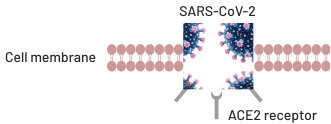
ACE2, angiotensin-converting enzyme 2.
COVID-19 is a multisystemic disease and can exacerbate other serious conditions3
COVID-19 may be associated with biological effects that extend beyond acute illness.8,9
50.7% (881 of 1739) of cancer treatment disruptions over 2 years of follow-up were attributed to COVID-1910
Patient screening and enrollment took place between May 2020 and February 2022.10

Most disruptions occurred in the first 30 days of SARS-CoV-2 infection and for most patients, the type of treatment disruption was a delay in receiving cancer treatment or clinical care.10
The National Cancer Institute COVID-19 in Cancer Patients Study (NCCAPS) was a prospective, longitudinal, natural history cohort study examining the impact of COVID-19 on >1500 patients with cancer. Adults were eligible within 14 days of an initial positive SARS-CoV-2 test result and if they received cancer treatment within 6 weeks prior to their first positive SARS-CoV-2 test result, expected to begin an eligible treatment within 2 weeks, or had received prior stem cell/bone marrow transplant or CAR T-cell treatment. The statistical analysis took place between September 2024 and April 2025.10
CAR, chimeric antigen receptor.
In a national, community-based, prospective cohort study of patients with multiple sclerosis (MS)8:
Out of 978 patients invited to complete a questionnaire, 404 patients responded. 230 (57%) of the responding patients reported an exacerbation, with 82 (20%) reporting new symptoms and 207 (51%) reporting worsening of pre-existing symptoms.
Additional survey background:
- Prospective cohort survey (UK MS Register, not randomized)
- Survey-based, patient-reported data on COVID-19 and MS symptoms
- Symptoms self-reported, without independent clinical confirmation
- No control group, limiting comparative/causal conclusions
- Potential biases (recall, symptom overlap with COVID-19) may affect findings
In a matched cohort study of patients with systemic lupus erythematosus (SLE)9:
14 patients (17.7%) with SLE from the
COVID-19 group experienced a lupus flare
as compared to 5 (6.3%) from the unexposed control group
In a national, community-based, prospective cohort study, the impact of SARS-CoV-2 infection on new and pre-existing symptoms of MS was evaluated in the UK. Individuals with MS who reported symptoms consistent with COVID-19 were invited to complete a questionnaire regarding changes in their MS symptoms during or shortly after infection between July 20, 2020, and January 25, 2021, as part of the UK MS Register. A total of 978 individuals with MS and COVID-19 were invited by email to complete a questionnaire about their MS symptoms during the infection. Of the 978 individuals invited, 404 (41%) responded. MS exacerbation was defined as development of new MS symptoms, worsening of pre-existing symptoms, or both during infection, as reported by the participant. Collected variables included age, sex, MS subtype, disease duration, disability status measured by the web-based Expanded Disability Status Scale (webEDSS), and use of disease-modifying therapies. Logistic regression analyses were performed to evaluate factors associated with changes in symptoms.8
A matched cohort study conducted in France evaluated the risk of SLE flare following hospitalization for COVID-19. The study used the Assistance Publique-Hôpitaux de Paris Clinical Data Warehouse, which aggregates structured medical and administrative data from 39 hospitals in the Greater Paris area. Among 4533 patients with SLE identified between July 15, 2017, and February 9, 2022, 81 patients hospitalized for COVID-19 between March 2020 and December 2021 met the inclusion criteria and were matched to 79 unexposed SLE controls using exact matching on age (±3 years), sex, chronic kidney disease, end-stage renal disease, and serologic activity. A flare was defined as physician-documented disease activity requiring modification of SLE treatment. The primary outcome was occurrence of flare during 6 months of follow-up, analyzed using Cox proportional hazards models accounting for matching.9
SARS-CoV-2 evolution can contribute to risk1,11,12
The unpredictability of SARS-CoV-2 can contribute to transmission and clinical risk across patient populations11,12
Prior immunity may not provide consistent protection against future variants.11,12
Some patients at increased risk of severe COVID-19 outcomes may require additional preventive strategies to help address persistent gaps in prevention.13,14

Emerging SARS-CoV-2 variants can reduce immune protection from prior SARS-CoV-2 infection or vaccination over time.11,12
COVID-19 is a year-round concern with 2 distinct surges during the summer and respiratory seasons15
Wastewater surveillance data for SARS-CoV-2 (virus that causes COVID-19) were derived from samples collected at wastewater treatment facilities participating in the CDC’s National Wastewater Surveillance System. Samples of untreated wastewater or sludge are collected and analyzed using PCR-based methods to measure viral RNA. Results represent aggregated, community-level data and are not attributable to individuals. Measurements may vary based on sample collection conditions, laboratory methods, and wastewater system characteristics.15
WVAL values for COVID-19 are categorized as very low (up to 2.6), low (>2.6 and up to 4.9), moderate (>4.9 and up to 7.9), high (>7.9 and up to 11.6), and very high (>11.6).15
CDC, Centers for Disease Control and Prevention; PCR, polymerase chain reaction; WVAL, wastewater viral activity level.
Recognizing at-risk patients starts with understanding key risk factors16-19
Many US adults have at least one factor associated with increased risk of severe COVID-19 outcomes.16-19
~64.6 million*
are aged 65 years or older17
~37 million†
have chronic kidney disease18
~16 million‡
have diagnosed chronic obstructive pulmonary disease19
*Based on 2025 US Census data.
†Based on the March 2026 CDC Chronic Kidney Disease in the United States report.
‡Based on the June 2024 CDC Chronic Disease Indicators data.

Your at-risk patients may need to consider all COVID-19 prevention options.


References: 1. Nextstrain. Genomic epidemiology of SARS-CoV-2 with subsampling focused on North America since pandemic start. Accessed August 17, 2026. https://nextstrain.org/ncov/open/north-america/all-time 2. CDC. Preliminary estimates of COVID-19 burden. Accessed September 16, 2026. https://www.cdc.gov/covid/php/surveillance/burden-estimates.html 3. Ashraf UM et al. Physiol Genomics. 2021;53(2):51-60. 4. Mallah SI et al. Ann Clin Microbiol Antimicrob. 2021;20(1):35. 5. Oudit GY et al. Cell. 2023;186(5):906-922. 6. Shirbhate E et al. Pharmacol Rep. 2021;73(6):1539-1550. 7. Hou Y et al. Open Forum Infect Dis. 2025;12(9):ofaf533. 8. Garjani A et al. Mult Scler Relat Disord. 2021;52:102939. 9. Mageau A et al. PLoS One. 2024;19(10):e0309316. 10. Rini BI et al. JAMA Oncol. 2025;11(9):990-998. 11. Chemaitelly H et al. Nature. 2025;639(8056):1024-1031. 12. Zabidi NZ et al. Viruses. 2023;15(4):944. 13. CDC. How to protect yourself and others. Accessed August 16, 2026. https://www.cdc.gov/covid/prevention/index.html 14. CDC. People with certain medical conditions and COVID-19 risk factors. Accessed May 7, 2026. https://www.cdc.gov/covid/risk-factors/index.html 15. CDC. National wastewater data for respiratory viruses. Accessed October 8, 2026. https://www.cdc.gov/nwss/rv/COVID19-national-data.html 16. CDC. Underlying conditions and the higher risk for severe COVID-19. Accessed October 8, 2026. https://www.cdc.gov/covid/hcp/clinical-care/underlying-conditions.html 17. US Census Bureau. QuickFacts: United States. Accessed September 16, 2026. https://www.census.gov/quickfacts/fact/table/US/PST045225 18. CDC. Chronic kidney disease in the United States. Accessed September 16, 2026. https://www.cdc.gov/kidney-disease/php/data-research/index.html 19. CDC. COPD. Accessed September 16, 2026. https://www.cdc.gov/cdi/indicator-definitions/chronic-obstructive-pulmonary-disease.html